
Analysis of the Urbach Tails in Absorption Spectra of Undoped ZnO Thin Films
Semiconductor Sub-Bandgap Optical Research Highlight
Zinc oxide (ZnO) is a wide direct band gap (Eg ∼ 3.40 eV) semiconductor with a large free exciton binding energy of 60 meV[1]. Understanding sub-bandgap absorption in the exponential rise edge (the Urbach tail) is essential for solving p-type doping challenges and advancing ZnO-based optoelectronic devices. We investigated variable-temperature (78 K – 450 K) optical absorption spectra of epitaxial undoped 150 nm ZnO thin films grown on (001) sapphire by electron-beam deposition to quantify the roles of structural disorder, impurities, and electron-phonon interactions[1].
Absorption Spectra & Urbach Rule Fitting
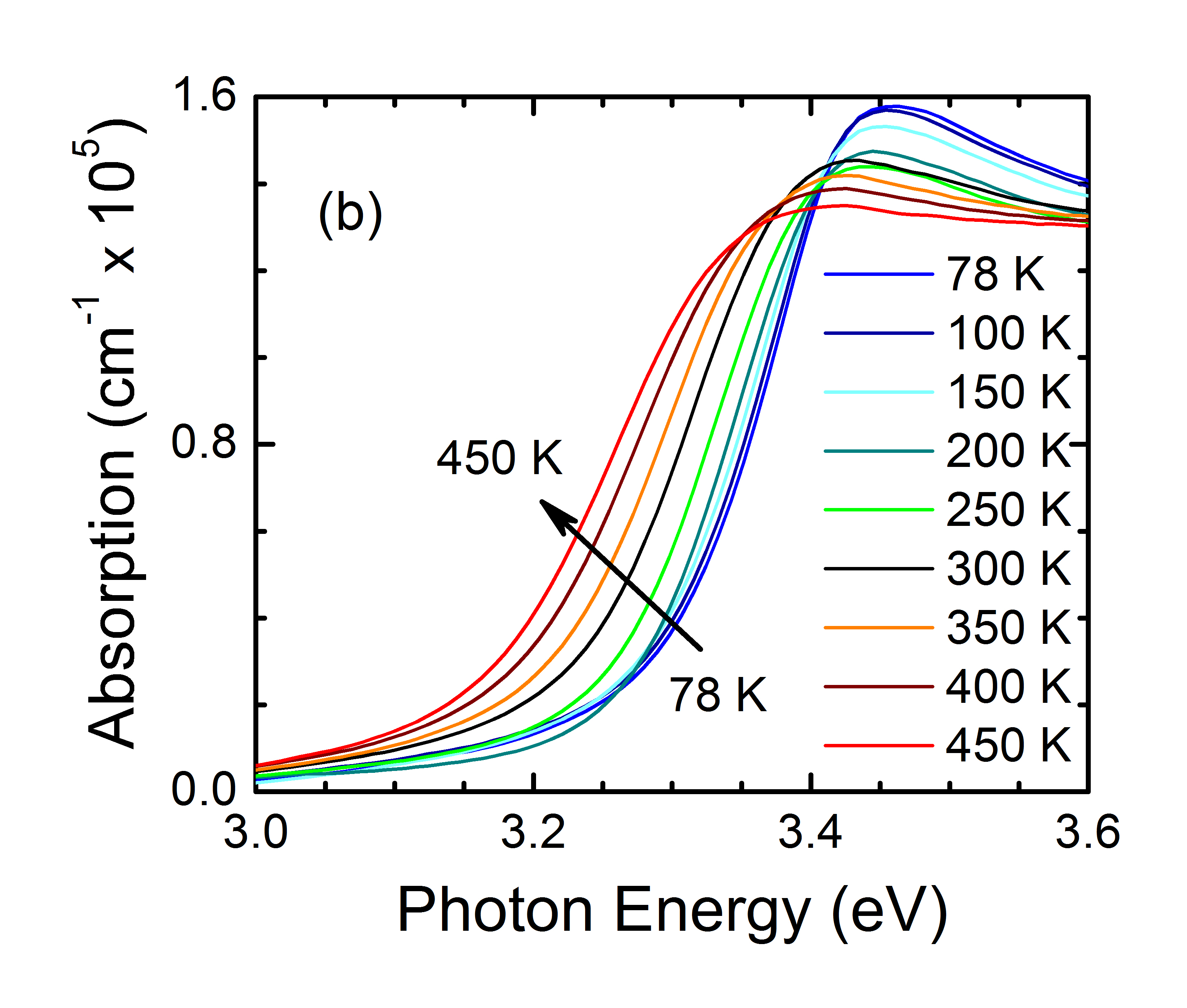
Exponential Absorption Edge: Optical absorption spectra measured between 78 K and 450 K show a strong free exciton resonance peak near ∼3.45 eV and a steep exponential tail in the sub-bandgap region[2]. Fits to the Urbach empirical relation, α(E) = α0 exp[σ(E − E0) / (kBT)], converge precisely to a focal point at E0 = 3.62 eV and α0 = 2.8 × 106 cm−1[2]. Previous investigations on ZnO single crystals and films confirm these exponential sub-bandgap features.
Exciton Binding Energy: An Arrhenius fit to the temperature-dependent integrated intensity of the free exciton peak yields a binding energy of Eb = 64 ± 7 meV, confirming the high crystalline quality of the epitaxial thin film[2].
Steepness Parameter & Disorder Models
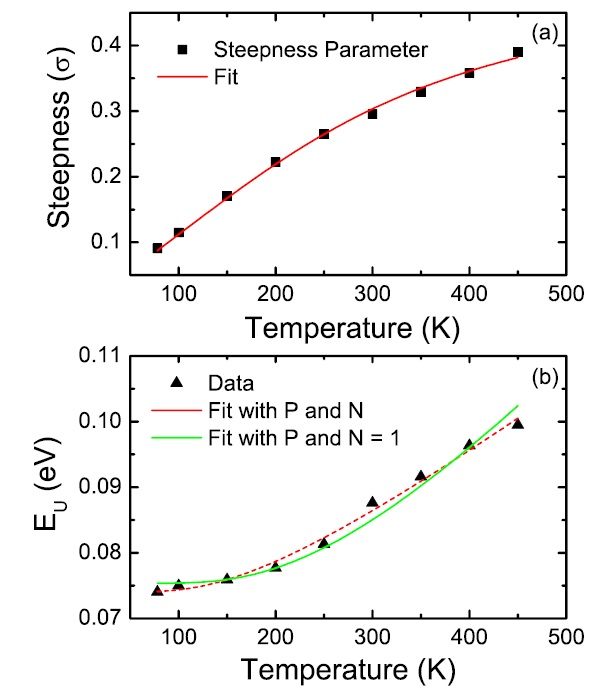
Phonon Energy Fitting: Temperature dependence of the steepness parameter σ(T) = σ0 (2kBT / ℏωp) tanh(ℏωp / 2kBT) yields an effective phonon energy of ℏωp = 76 ± 4 meV[2, 3]. This agrees remarkably well with the 72 meV optical phonon energy determined from photoluminescence measurements[1,3] as well as Raman and infrared active phonon modes spanning ~12 meV to ~73 meV[3].
Disorder & Thermal Coupling: Evaluation using Wasim's model accounts for both static structural disorder (P = 0.66 ± 0.07) and exciton-phonon interaction (N = 0.64 ± 0.05). The extracted characteristic temperature Θ = 515 ± 20 K corresponds to a Debye temperature of ΘD = 685 K[3].
Exciton Energy Shift & Eexc vs EU Linear Relation
Varshni & Bose-Einstein Models
Temperature shift of the free exciton peak was modeled with Varshni (α = 0.22 meV/K, β = 350 K) and Bose-Einstein parameters (aB = 24 meV, ΘB = 280 K). Subtracting thermal expansion contributions (ΔEth) yields a corrected Debye temperature of ΘD = 640 ± 50 K, consistent with Urbach energy modeling[3].
Direct Linear Coupling
A linear relationship is observed between the free exciton peak energy Eexc and the Urbach energy EU. This equivalence indicates that structural disorders directly modulate thermal lattice motions, demonstrating that structural and thermal disorder effects are directly coupled in ZnO thin films[3].
Conclusion
The exponential rise of the fundamental absorption edge in undoped ZnO thin films arises from the cumulative effect of unintended structural defects, native impurities, and strong electron/exciton-phonon interactions[1]. Low-temperature behavior is dominated by static structural disorders, while high-temperature absorption broadening is dominated by active phonon interactions (ℏωp ≈ 76 meV)[3].
Reference: R. C. Rai, J. Appl. Phys. 113, 153508 (2013).
Back to TopAdditional References cited:
1) D. W. Hamby, D. A. Lucca, M. J. Klopfstein, and G. Cantwell, J. Appl. Phys. 93, 3214 (2003).
2) L. Wang and N. C. Giles, J. Appl. Phys. 94, 973 (2003).
3) N. Ashkenov et al., J. Appl. Phys. 93, 126 (2003).