
Atmospheric Studies
Department of Geography and
Planning at Buffalo State
What is Meteorology and Climatology?
Meteorologists study the physical properties of the atmosphere – factors affecting the formation of clouds, rain and other weather phenomena. Meteorologists are most often employed as weather forecasters.
Climatologists collect, analyze, and interpret past weather data. Their work is applied to building design, human health, industry, agricultural production, and water management, to name but a few. Climatologists forecast long-term weather and study potential climate change.
Why
The Geography Program at Buffalo State College provides students with an Atmospheric Studies focus within the Geography Physical Concentration. Geography majors obtain a firm grounding in the skills related to the analysis of location and spatial patterns. Geographers are interested in how things are arranged spatially, how they came to be arranged that way, and how that information can be used to solve current problems and anticipate future patterns. These are problem-solving skills that are sought after in almost every field of employment. Geography provides an excellent context to study meteorology and climatology. Our emphasis is on application in meteorology and climatology, providing the student with a broad experience and a level of expertise to obtain employment in weather sensitive businesses or to enter graduate school in fields related to meteorology and climatology. The student may engage in an emerging field of study called Geographic Information Systems (GIS) Meteorology or explore the application of meteorology in air quality. The study of meteorology and climatology, rooted in the theory and skills of geography, provides the student with a broad range of opportunities that stretch beyond the traditional forecast meteorologist. Examples of employment opportunities for students with an atmospheric studies focus are listed on the last page of this packet.
Students may choose to “test the waters” toward a four-year meteorology degree offered at other colleges by first taking meteorology and climatology courses offered at Buffalo State College. The requirements for employment as a forecasting (operational) meteorologist with the National Weather Service require a four-year meteorology degree, that includes course work in mathematics and physics.
A Meteorology & Climatology Minor
may be taken at Buffalo State College. The minor may add a useful dimension to
the student’s major (e.g., a communications major positioning themselves to
work as a broadcast meteorologist or a forensic chemistry major studying the
implications of weather at a crime scene), positioning the student for an
alternative career option, or taken simply because the student has an interest
in weather.
Dr. Stephen Vermette,
A211
Telephone: 716/878-4930; E-mail: vermetsj@buffalostate.edu,
Web Page: http://www.buffalostate.edu/depts/geography

Facilities and Opportunities
Facilities:
The Geography and Planning Department supports two local weather stations, and a meteorology laboratory used for instruction, research and available for student use. The meteorology laboratory includes a number of computers, either to be used as individual stations or used together as a forecasting ensemble, simulating a computer array as used by the National Weather Service. Specialized state-of-the-art software applications are available for forecasting, broadcasting, and air pollution modeling. The meteorology lab archives weather data collected from 30 local weather stations, providing a database to study regional weather and climate, and for use in applied research. The Whitworth Furgeson Planetarium /Atmospherium is available for instruction, as well as a television broadcast studio. Weather-related equipment is available for instruction and student research.
Opportunities:
As a Geography Major (or registered in the Meteorology & Climatology Minor) you will be part of a small group of students receiving individual attention, and opportunities not available to students in larger programs. The department’s focus is on skills and applied experience. Aside from course work, students will have the opportunity to attend presentations and conferences, to take part in weather-related field trips, to join the American Meteorological Society (AMS), and to become involved with the Western New York Chapter of the AMS. Students are encouraged to become active, whether as a Snowspotter for the National Weather Office, as a weather anchor for BSC Cable 2 TV, or working with teachers and K-12 students in presenting and promoting meteorology and climatology. Opportunities exist for internships, independent study, and applied research.
Awards:
The Department of Geography and Planning recognizes the “Outstanding Graduate in Geography and Planning”. The “Updraft Award” is given for “Excellence in Atmospheric Studies”.
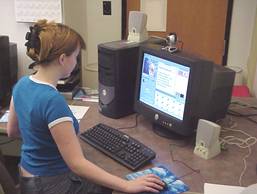
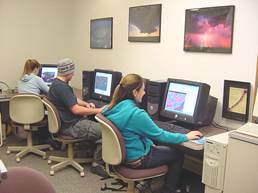
Preparing a web-based weather forecast and working in the Meteorology Laboratory.
Dr. Stephen Vermette,
A211
Telephone: 716/878-4930; E-mail: vermetsj@buffalostate.edu,
Web Page: http://www.buffalostate.edu/depts/geography
B.A.
Geography Degree (42 credits)
(Physical Concentration with Focus on Atmospheric Studies)
A focus in atmospheric studies may be taken within the B.A. Geography degree’s Physical Geography Concentration. The geography program provides students with a firm grounding in skills related to the analysis of location and spatial patterns. These are problem-solving skills sought after in almost every field of employment. Students receive a solid liberal-arts education, with a focus on spatial skills, and a content emphasis in meteorology and climatology.
Recommended Course outline
(courses selected by advisement):
A. Required Courses:
GEG 101 World Natural Environments
GEG 102 Human Geography
GEG 199 Computers in Social Science
GES/GEG 241 Meteorology
PLN 325 Map & Air Photo Interpretation
GEG 390 Quantitative Methods in Geography and Planning
GEG 430 Senior Thesis
B. Select one course:
SOC 300 Methods in Social Research1
PSC 300 Political Analysis
1 Prerequisites waived for Geography majors
C. Select one course:
GEG 357 Geography of
GEG 359 Arctic Geography from an Inuit Perspective
GEG 360 Geography of
GEG 362 Geography of the
GEG 363 Geography of
GEG 364 Geography of
D. Select four courses:
GEG 303 World Climatology
GEG 375 Principles of Hydrology
GEG 382 Weather Forecasting
GEG 384 Atmospheric Science
GEG 386 Applied Climatology
GEG 480 Air Pollution Modeling
GEG 488 Internship
Courses not selected from section “D” and others, by advisement, recommended as electives. It is also recommended that chemistry, mathematics and physics courses be taken to improve employment and graduate school opportunities.
____________________________________________________________________________________
Registration for the B.A.
Geography Degree requires completion of an application form and advisement from
Dr. Kim Irvine (Chair, Department of Geography and Planning)
Dr.
Stephen Vermette, A211
Telephone: 716/878-4930; E-mail: vermetsj@buffalostate.edu,
Meteorology
& Climatology Minor (18 credits)
A minor in meteorology may be taken along with any major (except Geography) at Buffalo State College. The minor may add a useful dimension to the student’s major, position the student for an alternative career option, or can be taken simply because the student has an interest in meteorology.
A. Required Courses (6 cr):
GEG 101 World Natural Environments
GES/GEG 241 Meteorology
B. Choose three from the following (9 cr):
GEG 303 World Climatology
GEG 382 Weather Forecasting
GEG 384 Atmospheric Science
GEG 386 Applied Climatology
C. Choose one from the following (3 cr):
Any course not selected to fulfill section B.
GEG 375 Principles of Hydrology
GEG 480 Air Pollution Modeling
GEG 488 Internship
GEG 499 Independent Study
Registration for the Meteorology Minor requires completion of an application form and advisement from Dr. Stephen Vermette (Meteorology & Climatology Minor Coordinator).
For more information about meteorology/climatology courses, the B.A. Degree in Geography with Meteorology / Climatology Content Emphasis, or the Meteorology Minor, contact:
Dr. Stephen Vermette,
A211
Telephone: 716/878-4930; E-mail: vermetsj@buffalostate.edu,
Web Page: http://www.buffalostate.edu/depts/geography
Meteorology and Climatology Courses
Department of Geography and Planning at Buffalo State
GEG 101 – World Natural Environments:
Nature of Geography; earth-sun relationships; maps and map interpretation; and classification, distribution, and origins of the major elements of the natural environment: weather, climates, soils, natural vegetation, and landforms.
GES/GEG 241 – Meteorology:
An introduction to weather, including prediction, meteorological instruments, atmospheric movements, humidity and precipitation, high and low pressure areas, air masses and fronts, and heat balance, and climates past and present.
GEG 303 - World Climatology:
A study of the Earth’s climate through an analysis of climatic controls, classification schemes and feedback cycles. Includes an examination of past global climates and global climate change scenarios.
GEG 382 – Weather Forecasting:
A focus on synoptic and dynamic meteorology, as applied to weather forecasting. Weather conditions are diagnosed using various case studies. Students learn how to develop and present weather forecasts. Emphasis is on practice, and interpretation of daily weather and modeled data.
GEG 384 – Atmospheric Science:
Study of the Earth’s atmosphere as a unique place. Emphasis is on atmospheric structure and composition, dynamics of motion, moisture and clouds, atmospheric chemistry, regional and local air pollution, aurora displays, and optical phenomena. Includes a study of atmospheres ranging from those of other planets to indoor air.
GEG 386 – Applied Climatology:
Use of climatic information in various aspects of our lives to solve practical problems with environmental, social, and economic implications. A focus on the importance of climate on agriculture, human health, severe weather management, litigation, commerce, architecture, and city planning.
GEG 480 – Air Pollution Modeling:
Study of receptor, dispersion, and risk assessment modeling techniques to determine the source, fate, and impact of air pollutants. Overview of atmospheric deposition, regional transport, and global circulation models.
For more information about meteorology and climatology courses, the B.A. Degree in Geography with Atmospheric Studies focus, or the Meteorology Minor, contact:
Dr. Stephen Vermette,
A211
Telephone: 716/878-4930; E-mail: vermetsj@buffalostate.edu,
Web Page: http://www.buffalostate.edu/depts/geography
Employment
Opportunities
Physical
Geography Concentration with an Atmospheric Studies Focus
Title: Meteorologist/GIS Associate
Duties: Develop spatially-referenced web portal to view real-time weather forecasts.
Qualifications: Bachelors degree in meteorology or physical geography.
Company: National Oceanic and Atmospheric Administration
Title: Staff Scientist
Duties: Provide technical support for air quality studies, conduct dispersion modeling.
Qualifications: Environmental science with some course work or experience in atmospheric science.
Company: Earth Tech
Title: Meteorologist/Educator
Duties: Development of K-12
educational materials.
Qualifications: Degree in
Education and a minor in meteorology
Company:
Title: Physical Scientist
Duties: Responsible for atmospheric portions of applications of permits
Qualifications: A general physical science discipline with emphasis in atmospheric sciences.
Company: The
Title: Meteorological Software Developer
Duties: Software developer
Qualifications: A software developer with a meteorological background.
Company: WeatherData, Inc.
Title: Radio Broadcast Meteorologists
Duties: Provide weather forecasts and severe weather coverage for radio stations nationwide.
Qualifications: Broadcast skills and a working knowledge of meteorology
Company: The Weather Channel
Title: AWS Program Manager
Duties: Planning and implementing weather programs with television stations.
Qualifications: College degree, background in television sales preferred.
Company: AWS Convergence Technologies, Inc.
Title: Flight Coordinator
Duties: Creation of completed flight plans and dissemination of flight planning and weather information.
Qualifications: Bachelors degree in technical area or equivalent, with weather/meteorology experience.
Company: ARINC Incorporated
Title: Professional Scientist
Duties: Calculate source emissions, prepare air pollution applications, and understand regulations.
Qualifications: Bachelors or Masters degree in one of the following disciplines…environmental science, meteorology (for air pollution modeling). Prior work experience including student internship.
Company: RTP Environmental Associates, Inc.
Title: Meteorologist
Duties: Forecasting weather parameters and issuing alert statements for industrial and commercial clientele.
Qualifications: B.S. in Meteorology or a related field.
Company: WeatherBank, Inc.